1993: History and Philosophy
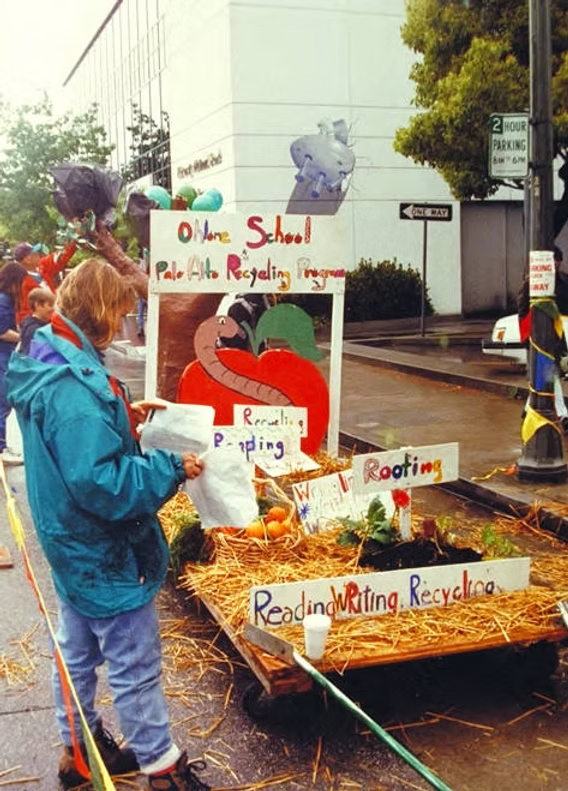
Ohlone School is an officially designated district alternative school (or school of choice) with voluntary enrollment from throughout the District. The school has about 390 students and children are admitted using a combination of a waiting list and an equal access drawing (lottery) held a year preceding enrollment.
The school program is what is usually called "open education," with classrooms that are characterized by pupil-initiated activity, independent study, pupils progressing at their own rate, peer tutoring, and the teacher functioning as a guide and facilitator of learning. Classrooms are multi-age, and feature a relaxed, informal atmosphere with an integrated day schedule.
The basic goal of Ohlone is to help each child acquire the tools of learning -- reading, oral and written language, mathematics -- in such a way that the child experiences a joy of learning, is able to use these tools to further his or her learning, and has the desire to further his or her learning.
The school has gained wide recognition during the past seventeen years, since the staff developed the open education approach. Many educators and parents visit the school each year. Articles describing the school have been published in Learning magazine, The Christian Science Monitor, and local newspapers. Staff members have authored articles describing various aspects of the program. Several teacher-training institutions regularly send student teachers to the school.
Parent support has been strong. A school advisory committee was formed in 1973 to promote parent involvement in school policy development and program evaluation. This committee has evolved into the Ohlone School Site Council. The school has a very active PTA: among other things, parents raise funds to enhance the school program; organize and support myriad school-wide activities and events; volunteer in classrooms as tutors; drive on field trips; assist in operating a lunch-time drop-in art program; provide noon supervision on the Ohlone Farm; and help in the school library.
Student achievement is at a very satisfactory level, as evidenced by standardized test scores: more than 50% of our students score in the top quartile (national norms) on reading, language arts, and mathematics tests, while fewer than 5% score in the bottom quartile. Although there is a high rate of learning for most students, staff and parents concentrate efforts on target remediation for those students who need it and provide enrichment for all Ohlone students.
The school, with its program intact, was moved from south Palo Alto to its present site in 1982, as part of a districtwide reorganization and school closure program.
The staff has developed several written statements to assist parents and visitors in understanding the school program. The Ohlone Code is one of these statements. The beliefs, practices, and assertions given here represent the collective position of the Ohlone staff. The Code serves three purposes:
to inform visitors and parents of prospective students about the basic beliefs upon which the school program is based;
to serve as a guide to the staff in decision-making;
to clarify for the District administration and School Board the distinctive aspects of the Ohlone Open School Program.
The code was written, revised, and adopted by the staff during the 1976-78 school years, and is periodically reviewed and revised. It has been endorsed by the Ohlone PTA and School Site Council.
We believe that curriculum and instruction need to be meaningful and relevant to each student so that he or she becomes a thinking, probing learner who searches for understanding.
Students are empowered and encouraged to develop their own learning goals and activities with the teacher as a facilitator who is responsive to individual needs. The classroom provides for a variety of learning styles and for cooperative, interactive and individual activities.
Practices:
Teachers encourage responsible choice-making by students. Choices may be: what to study (choosing a report or project topic); what material to use (type of independent reading program or art media); and how to evaluate learning.
Teachers help students set appropriate goals (daily, weekly, or longer), and provide students with an organizational structure to support student planning and achievement of goals. Occasionally students will fail to reach goals this can also be a valuable learning experience. Students and teachers can renegotiate goals where necessary.
Teachers invite and encourage student-initiated projects (short- and long-term). Resources, an integrated day, and flexible scheduling support the completion of projects. Some projects are undertaken within a classwide theme, while others are done individually. Student time spent on projects must be balanced with other curricular demands.
A spiral and integrated curriculum allows students to deepen their understanding by learning subject matter and skills in context and returning to them at successive developmental levels.
Teachers organize activities so that children learn to cooperate and encourage one another. Teachers devote part of every day's instruction to developing positive, productive human relationships in each classroom.
State curriculum frameworks and the District's "What We Teach" and outcome statements serve as guidelines in the various subject areas.
We believe that the ultimate goal of education is the balanced person. Consideration is given to those areas of a child's development that are strong and those that need nurturing. Students' self-esteem, individual needs, concerns, and fears are addressed by teachers, adult volunteers, and peers. Students are encouraged to recognize their own strengths and weaknesses as well as those of others.
Practices:
Participation in class meetings empowers and enables students to take risks and express themselves in a non-judgmental atmosphere.
The staff, through its own warmth and ability to create a safe and accepting environment, encourages students to treat themselves and others respectfully and act in positive ways.
The staff strives to develop trust and respect among students, among adults, and between adults and students.
A CARE program of social skill-building groups is available to help students develop a strong base for positive social interactions.
We believe that the assessment of student achievement is an on-going process involving a cycle of observation, reflection and change. It focuses on individual growth and provides for open lines of communication among parents, students and teachers. Students are encouraged to be an integral part of the assessment process both formally and informally. Evaluation is a positive learning tool which encourages the joy of learning and motivates each student to achieve his or her highest potential.
Practices:
Students progress at their own level and rate.
Progress that students demonstrate in daily classroom work is of greater value than standardized tests for evaluating student achievement.
Parent-teacher conferences and written evaluations take the place of letter grades and report cards.
Homework is an extension of the classroom curriculum, rather than a separate, non-related activity.
Standardized tests are given only when mandated or appropriate for instructional purposes.
We believe that optimal learning focuses on the whole child in an environment that empowers students to make decisions, gives them freedom to explore their own interests, encourages risk-taking, and ensures that learning is relevant and meaningful. This environment extends beyond the classroom and provides a safe, trusting, nurturing place where children celebrate the joy of learning.
Practices:
We utilize multi-age grouping so that students have the opportunity over a period of at least two years to be both a younger and an older student in the same classroom.
We encourage and enable children to teach and serve as role models for one another (via peer tutoring, cross-age tutoring, and cooperative learning).
Children have the freedom to move around and talk and share with one another.
The Ohlone Farm provides students with unlimited opportunities for "hands on" learning.
We encourage field trips into the community.
We encourage and promote the use of classroom volunteers, including older Ohlone students, peers, parents, and community members.
We emphasize using manipulative materials and incorporating real-life experiences into the curriculum.
We hold daily class meetings to plan, evaluate, settle concerns, and celebrate progress.
Most classrooms have loft areas for reading and quiet work.
We provide an integrated-day schedule, in which several activities can occur simultaneously in the classroom or in which all students may work together on an activity or project.
The teacher functions as a guide and facilitates learning.
We believe the Ohlone School climate is one which promotes a trusting relationship among all members of the school community. Our school environment allows for children to develop a positive attitude towards learning and encourages them to be part of the learning process. It also develops an understanding of individual differences and the ability to work together.
Practices:
To the greatest extent possible, students and staff members participate in making decisions that directly concern them, whether as members of a classroom study group, total classroom group, cluster group, or the entire school.
Written rules and regulations, when needed, are democratically developed and periodically reviewed.
We encourage students to initiate activities and enable them, with support, to follow through.
We maintain a relaxed, informal atmosphere in classrooms and on campus; children and adults call each other by their first names.
We emphasize positive, productive human relationships in the classroom and on the playground. When arguments arise, we emphasize problem solving and conflict resolution through discussion leading to agreements and understanding.
We encourage and enable students to make choices and take responsibility for their choices, including accepting the natural consequences of those choices.
Students and teachers mutually determine classroom standards every year.
We believe that Ohlone teachers and parents are partners who work together to support the students and the school programs. The success of Ohlone School depends not only on parent commitment but also on the support and resources of the community.
Practices:
We encourage parents' awareness of and involvement in school activities in a variety of ways, such as visiting classrooms, volunteering, attending conferences with the teacher, supporting total school projects, taking workshops, and participating in ongoing parent education opportunities. We encourage and invite frequent classroom observations by parents.
We recognize and involve the talents of parents and community members as much as possible in order to support and enrich the many school programs.
We welcome parent participation in decision-making and policy formation through the School Site Council.
We consider the regular involvement of parent and community volunteers in the classroom an integral part of the school program. It is our intention to promote a sense of partnership in the education of our children through such involvement.
We believe that the quality of the Ohlone alternative depends on the staff's understanding of and commitment to the philosophy as stated in this Code.
Practices:
The School Board and administration have authorized the Ohlone alternative. We encourage their continual efforts to staff the school in a way that supports the beliefs and practices expressed in this Code.
We expect that teachers, support staff members, and administrators be assigned to Ohlone School with their complete willingness to accept the beliefs and practices expressed by this Code.
When openings occur on the staff, we include both parents and staff members in the procedure to fill the vacancy.
As a staff, we recognize the need to update and renew teaching practices and educational philosophy so as to review and refine the open education program, and we seek to do this through workshops, retreats, and in-service programs.
Students participate in deciding portions of content, learning materials, method of study, and use of time.
When there are District objectives affecting Ohlone, the Ohlone staff determines whether they are compatible with our principles and practices. If we find the District objectives incompatible, we seek to have them changed or eliminated for Ohlone.
Whenever possible and practical, the decision-making process includes those who are affected by the decision. On some occasions, representatives advise on a decision. Decisions are made with the principles of this Code as a guide.
We accept the responsibility to provide educational experiences for children that are appropriate to their present needs as the best way of preparing them for future educational levels. We regard as damaging attempts to pressure a student or teacher to meet a particular educational curricular norm not appropriate for a particular student's conceptual maturity, interest, or level of skills development.
We expect parents and students considering enrollment at Ohlone to visit classrooms, to discuss this Code, and to indicate their understanding of the Ohlone Philosophy and its value to them.
We expect students to work and play with awareness of and respect for the rights of others. We employ a variety of strategies to help a child meet this expectation including:
individual conferences group discussion
role playing
contract agreement
temporary exclusion (time out)
the opportunity to express feelings in writing
conferences with parents
If a student does not benefit from such approaches and would function better in a learning environment other than an open school, his or her parents are so advised.
Teachers measure students' progress with the forms of measurement we find useful. We examine standardized tests required by the District for their suitability. If we determine that a particular standardized test is inappropriate, we strive to replace it with a more suitable measuring instrument.
The beliefs, practices, and assertions in this Code represent our definition of open education as it is implemented at Ohlone.
The school's boundaries embrace the whole school district, not an immediate neighborhood. Parents choose to send their children to Ohlone instead of to their neighborhood school.
The school offers a continuity from room to room and grade to grade centered around a common philosophy.
The staff has a coherent philosophical point of view; while individual differences do exist among teachers, there are common practices which occur in all classrooms.
Siblings of present and former Ohlone students and students participating in the Voluntary Transfer Program receive first priority for admission to Ohlone. Admission for the remaining available spaces is currently determined by a combination of a waiting list and an equal access drawing (lottery) held six months before a child's initial enrollment. For the Kindergarten class entering in 1996, all remaining available spaces will be filled by the equal access drawing.
The curriculum is open-ended, allowing a child to progress at the rate best for him or her.
With the current exception of two kindergarten classes and one third grade class, classrooms embrace at least a two-year age span among students.
There is individualized, personalized instruction.
We emphasize cooperation and individual progress, rather than competition.
Children make decisions about the use of their time within reasonable classroom expectations.
We teach reading, writing, mathematics and other academic cognitive subjects as skills used to broaden learning.
We emphasize social skills such as problem solving, human relations, and peer cooperation.
We hold daily class meetings to plan activities, solve problems, and evaluate progress.
Children to learn through hands-on manipulation of learning materials, especially in the primary grades.
Parents are actively involved in the school.
The basic goal of Ohlone is to help each child acquire the tools of learning reading, oral and written language, mathematics in such a way that each child experiences a joy of learning, is able to use these tools to further his learning, and has the desire to further his learning.
Ohlone evolved from a neighborhood to an alternative school between 1970 and 1974. During this period teachers received specially-funded professional in-service training in open education, and gradually adopted new practices. The PAUSD School Board officially designated Ohlone as an alternative school in 1976. The school moved to its present location in 1982.
Parents are encouraged to visit classrooms, volunteer in the classrooms or at the school, be active in the PTA and on the Site Council, and are expected to attend parent-teacher conferences which are held at least twice a year.
Parents staff the noon art program, supervise Farm activities, help in the Library, and raise funds for classroom and school enrichment activities and materials.
Quoting from recent visitors to the school, the following are frequently observed:
"Children reading, writing, and enjoying."
"Children being able to make decisions."
"An outstanding arts program encompassing music, drama, literature, and the visual arts."
"A close teacher-pupil relationship."
"Children who are happy, relaxed, and yet very productive."
"Aides in every classroom."
"A warm, accepting atmosphere."
parents' comments,
teachers' reports to parents in the end-of-the-year letters,
annual reports of standardized test results,
follow-up studies of students who go on to middle school,
the children themselves.
Visit the school, preferably for half a day when you will be able to visit classrooms with children the same age as your own.
Read the Ohlone Code, which is available in the office, and be sure that you agree with the philosophy presented in the Code.
If you wish, make an appointment with the school principal to discuss your children and the Ohlone program.
Talk with parents of children currently attending Ohlone.
Attend an evening orientation session held the November before your child's entrance into Kindergarten or view a videotape of that session in order to become more familiar with our principles, practices, and expectations.
Enter your child's name into the pool for the Equal Access Drawing which takes place every January before enrollment.